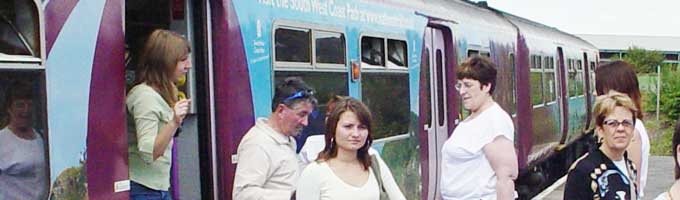
Save the Train forum

Dedicate to campaigning to retain an appropriate "TransWilts" passenger train service ... Swindon - Chippenham - Melksham - Trowbridge - Westbury - Dilton Marsh - Warminster - Salisbury ... and to other services too

THIS FORUM IS NOW A READ-ONLY ARCHIVE. Please use our Coffeeshop Forum for new posts

link to main site
Save the Melksham Train

Welcome, Guest. Please login or register.
February 10, 2012, 01:14:18 AM

Login with username, password and session length
Search:     Advanced search
Recommended service - hourly, according to the GWRUS. Let's work towards that service and towards ensuring all services are used.
7889 Posts in 5009 Topics by 84704 Members
Latest Member: Seelefems
* Home Help Search Calendar Login Register
+  Save the Train
|-+  General Discussion
| |-+  The Future
| | |-+  Hopwood In Talks With New Government Over Electric Bid
0 Members and 1 Guest are viewing this topic. « previous next »
Pages: [1] Print
Author Topic: Hopwood In Talks With New Government Over Electric Bid  (Read 2473 times)
Lee
Administrator
*****
Offline Offline

Posts: 3633


View Profile WWW
Hopwood In Talks With New Government Over Electric Bid
« on: June 16, 2010, 09:58:36 AM »

From SouthWestBusiness:

Quote from: SouthWestBusiness
Train boss in talks with new Government over electric bid

The boss of First Great Western has admitted that there are major doubts surrounding the £1 billion plans to electrify the main rail route between London and Bristol.

The project was a key part of Labour's transport policy and would slash rail journey times between Bristol and the capital by as much as an hour.

But in an exclusive interview with the Evening Post, First Great Western managing director Mark Hopwood revealed that his company is in talks with the new Coalition Government over the future of the scheme.

He said: "Electrification does make sense in terms of reliability and the cost of running the service, but in the current climate we have to be realistic when it comes to spending on major projects.

"However, the Government is still going to have to take a view. The high speed trains we use on that route are now 34 years old and reaching the end of their life span.
 
"Whatever happens, the trains will have to be replaced in 2013 and it would be a real challenge for us to refurbish them."

Mr Hopwood took charge of the company more than two years ago at a time when it was fighting for its future.

The franchise had one of the worst records in the country in terms of punctuality, cancellations and creations. Many passengers were threatening to boycott the company altogether and at one stage the Government warned that unless the situation improved it would remove its franchise altogether.

But the company is now one of the best performing in the country and passengers numbers are increasing by around 10 per cent each year.

Mr Hopwood said: "We have gone about our job quietly and I guess the fact that there are no longer protests or people waving placards outside stations tells you everything you need to know.

"We changed the way we do things at First Great Western by putting our customers at the centre of everything. In many ways we have become victims of our own success because we are reaching maximum capacity on many of our busiest roots."

First is expecting to bring in extra carriages next year but they will largely replace rolling stock currently on hire from other operators.

Mr Hopwood added: "We are in talks to increase rolling stock but anything we get is likely to be minimal. There are some areas where we still need to improve and we are aware of that."

Unsurprisingly, Mr Hopwood defended the cost of rail fares during peak times. He said: "When you compare travelling by train it is a lot cheaper than using a car if you take into account the cost of petrol, parking and tolls on the Severn Bridge.

"Travelling by rail is more popular than it has been for years. Bristol has always struggled with congestion and if you took rail travel out of the equation then the situation would be much, much worse than it is now."

Further related article links - http://www.theboltonnews.co.uk/news/8220800.End_of_the_line_for_electrification_/

http://news.bbc.co.uk/1/hi/england/merseyside/10333410.stm

Also, from Railnews:

Quote from: Railnews
Growing gloom over electrification prospects

The chances of electrification of the Great Western Main Line and several key routes in the north west in the foreseeable future appear to have dwindled to almost zero. The House of Lords has been told that the national financial situation poses difficulties.

Lord Attlee, answering a transport question from Lord Faulkner, said: "My Lords, we are committed to High Speed 2, but the noble Lord will understand the problems with expenditure on electrification in the current economic climate."

He also told the House that additional carriages were 'desirable', but that there was an 'affordability problem' with them as well.

The Department for Transport has already been required to slash £683 million from its budget, while early electrification is also being questioned by the chief executive of Network Rail.

Iain Coucher told Railnews that if the Thameslink rolling stock programme is delayed, and with the current question marks over Intercity Express, electrification might not be worthwhile because there could be no electric trains available for these routes anyway.

He said : "We have to face the fact that rolling stock orders are now looking less certain. Intercity Express has been placed in question by Government, at least in its present form, and we haven’t seen the promised report on that yet in any case, which is looking at the value for money question once again.

“The new Thameslink rolling stock, which was to have been ordered in two phases, is also being re-examined. If the larger second phase, in particular, didn’t go ahead as planned, then we won’t have Class 319 units freed up from Thameslink to cascade to Great Western suburban and the north west. And if we don’t have the 319s to run to Oxford and Newbury, what’s the point in electrifying those lines so quickly?

“For that matter, we should be questioning whether we should be going ahead for now with all our plans to lengthen platforms to 12 cars, if we won’t be getting the 12-car trains just yet.”

It has also been speculated that electrification could be cut back, rather than postponed altogether, but Mr Coucher points out that there are problems with that approach as well.

“Take Great Western. We know Airport Junction to Maidenhead is to be electrified for Crossrail, and there are plans to take the wires on to Reading. But then what? Let’s say we are asked to go as far as Didcot and Oxford. We’ll be asked to keep the cost per kilometre down to where it would have been had we gone through to Bristol and Swansea, but railway engineering doesn’t work like that.

“We would lose the economies of scale. The Swansea project would have involved factory trains working steadily down the route, with the piling gangs in advance of them. But we won’t be so efficient doing shorter sections, however hard we try. The cost per kilometre will be higher. And, as I say, what’s the point, at least for now, of committing funds to electrifying routes which may not have any electric trains for the time being ?"

More details of Mr Coucher's exclusive assessment of rail industry prospects are published today in the latest print edition of Railnews.
« Last Edit: June 17, 2010, 10:44:04 AM by Lee » Logged
Lee
Administrator
*****
Offline Offline

Posts: 3633


View Profile WWW
Re: Hopwood In Talks With New Government Over Electric Bid
« Reply #1 on: June 21, 2010, 10:30:01 AM »

From This Is Wiltshire:

Quote from: This Is Wiltshire
Electrification of line in jeopardy

Plans to electrify First Great Western’s main line through Swindon could be scrapped as the Government attempts to claw back the £1 billion set aside to fund it.

The project, introduced by the former Labour Government, was set to be completed in phases, electrifying lines first between London and Swansea through to Swindon.

The completion was scheduled to coincide with the introduction of a new fleet of electric super express trains in 2016/2017.

But in the House of Lords Earl Attlee, speaking for the Government, said during question time that there were “problems” with spending money on electrifying lines given the state of public finances. He told peers: “You will understand the problems about expenditure on electrification in the current economic climate.”

Coun Peter Greenhalgh, Swindon Council’s cabinet member for sustainability, strategic planning, property and transport, said: “We have billions of pounds of debt left by the previous Government and there are going to have to be cuts to deal with them.

“It’s disappointing news, but it’s the sort of thing we’re probably all going to have to get used to.”

Meanwhile, the Department for Transport (DfT) has moved to reassure passengers that it still supports electrification of the lines as a method of reducing carbon dioxide emissions and running costs.

A spokesman said: “We recognise that electric trains generally offer a range of further benefits to passengers – faster journey times, greater reliability and improved air quality.”

But he conceded: “We are in the early stages of the new Government and ministers are considering the full range of transport policy to ascertain what is affordable.”

A spokeswoman for Network Rail, which maintains the railways, said there was a “strong” business case for electrification but officials were still waiting for a decision from the DfT over funding of schemes.

She added: “The fact is, for the benefits of electrification to be gained, any scheme would have to coincide with the introduction of electric trains.

“This introduction of electric trains for the Great Western route is being reviewed by the Government. However, there are enormous benefits from electrification with faster, quieter, smoother, greener journeys.”

A spokeswoman for train operator First Great Western said: “Electrification is great for customers in terms of reliability and the costs of running the service.

“However, in the current economic climate, we understand that the Government has to look at value for money in terms of projects like this and we continue to talk to the Dft about its plans.”
Logged
Lee
Administrator
*****
Offline Offline

Posts: 3633


View Profile WWW
Re: Hopwood In Talks With New Government Over Electric Bid
« Reply #2 on: July 03, 2010, 10:20:33 AM »

From Herald Scotland:

Quote from: Herald Scotland
Electrifying railways decision is welcome

Postponing future projects is always less painful than cutting current ones.

Major infrastructure programmes which can be put off without financial penalty would, therefore, seem to be among the first casualties of public spending since cuts.

Such judgments, however, must also balance the advantages of short-term savings against the potential boost to economic recovery of investment in strategic developments, including transport networks.

The political and economic arguments over which is likely to be the more successful strategy is about to be tested by a difference in approach between the Department for Transport in England and Transport Scotland.

The obvious benefits of electrifying the most heavily-used parts of the Scottish rail network to provide faster journey times between Glasgow and Edinburgh, and better links to the travel-to-work areas around each city, guaranteed support for the Edinburgh Glasgow Improvement Programme (Egip). At a cost of £1bn, it must have been a candidate for the axe at a time when all public spending is scrutinised for potential savings.

The electrification of 200 miles of rail routes between the two cities, including the Bathgate line plus the branch line to Stirling and Alloa, however, has been spared by Transport Scotland because of its potential to revolutionise the vital rail links in central Scotland.

The funding of the scheme through Network Rail, which uses the rail track as collateral and is able to obtain low rates of interest because loans are underwritten by the UK Government, means the savings made from cancellation can be regarded as relatively small. But the Department for Transport in England has postponed two schemes funded by the same mechanism: the electrification of the Great Western Main Line between London and Wales, which it described last year as of vital national strategic importance to both England and Wales, and the line between Liverpool and Manchester, which would enable electric trains to operate between Manchester and the West Coast Main Line services to Glasgow and Edinburgh. In Scotland, the decision to go ahead coincides with two economic forecasts of slow economic growth and high job losses, raising the prospect of much deeper cuts elsewhere to compensate for the cost of funding Egip.

The Fraser of Allander Institute at Strathclyde University warned this week that the risk of another recession in Scotland had been considerably increased by the fiscal consolidation package in the Conservative-Liberal Democrat coalition’s emergency Budget. That was based on the impact of a 14% real terms reduction in the Scottish budget by 2014/15, equivalent to the loss of between £4bn and £4.5bn a year. These calculations, however, assume a continuation of the Barnett formula. If that were to be changed to adopt the proposals of the Calman Commission, with the Scottish budget partly based on tax receipts from north of the border, there would be a bigger cut in the budget and heavier job losses.

As economists at Edinburgh and St Andrews universities showed in a letter in The Herald yesterday, under the Calman system, Scotland’s budget revenues would have been more than £500m lower in the current financial year. That bleak scenario underlines the case for substantial investment in the most heavily-used rail route in Scotland as economically justified in terms of increasing revenue which will pay back the cost. But that benefit must be accurately quantified. As we know from major infrastructure projects, with spiralling bills such as the Edinburgh trams project, there are dangers in failing to impose rigorous cost controls.

There are other aspects to be taken into consideration, such as the greener electric trains, which are cheaper to run. Although that is not an immediate gain, improving the rail network across Scotland’s most densely populated areas will extend ease of access to both Glasgow and Edinburgh to a large number of people who may have to travel further to find work as jobs are cut.

This is a case where cost-benefit ratio is crucial. The investment must be phased in a way which gains significant advantage from the early stages. The Scottish Government has made a bold but, on balance, a welcome decision.
Logged
chris from nailsea
Administrator
*****
Offline Offline

Posts: 23


View Profile
Re: Hopwood In Talks With New Government Over Electric Bid
« Reply #3 on: July 03, 2010, 10:55:23 AM »

Quote
But the Department for Transport in England has postponed two schemes funded by the same mechanism: the electrification of the Great Western Main Line between London and Wales, which it described last year as of vital national strategic importance to both England and Wales ...

Eh??  When was that announced?
Logged
Lee
Administrator
*****
Offline Offline

Posts: 3633


View Profile WWW
Re: Hopwood In Talks With New Government Over Electric Bid
« Reply #4 on: July 03, 2010, 11:06:24 AM »

I thought that - plenty of hints, but not seen any official confirmation...
Logged
Lee
Administrator
*****
Offline Offline

Posts: 3633


View Profile WWW
Re: Hopwood In Talks With New Government Over Electric Bid
« Reply #5 on: July 23, 2010, 04:57:13 PM »

From Railnews:

Quote from: Railnews
New doubts over Great Western electrification

The transport secretary has signalled fresh doubt over the likelihood of electrifying the Great Western Main Line to Bristol and Swansea. Plans to upgrade the route were announced by the former Labour government last year, but Philip Hammond has now warned that the pledge may not have been justified.

The scheme is currently on hold, while post-election departmental spending plans are placed under the Treasury microscope, but Mr Hammond has told the Western Mail that electrification needs to be 'examined in the cold light of day'.

It had been expected that the £1 billion project would have been financed by more Network Rail borrowing. However, this is already at almost £24 billion, and the government is considering whether the company's debts should be included in the national balance sheet, and therefore become part of the Public Sector Borrowing Requirement. If this happened, more Network Rail borrowing could become very difficult, because Treasury approval might well be withheld.

Mr Hammond explained: “I don’t think a full cost-benefit analysis was carried out before Lord Adonis made the announcement in the run-up to the election. We’ve made it very clear that we’re not going to allow our approach to Network Rail to be driven by artificial accounting practices. That does mean we can’t take quite the cavalier approach the previous government took to Network Rail borrowing.”

The Western Mail reports that abandonment of the plan would cause 'distress' in south Wales. Electrification had also been supported by the Welsh Assembly Government.

Meanwhile, the Department for Transport has announced proposals to award longer passenger franchises in future, perhaps lasting 15 years, and a period of consultation is now under way.
Logged
Lee
Administrator
*****
Offline Offline

Posts: 3633


View Profile WWW
Re: Hopwood In Talks With New Government Over Electric Bid
« Reply #6 on: August 04, 2010, 03:15:12 PM »

From Wales Online:

Quote from: Wales Online
Government ‘can afford to wait’ over Wales’ electric railway decision

Wales is the only country in the economically developed world which has no electrified railway lines. This is not through want of trying, however.

When the Great Western Main Line (GWML) from Paddington was electrified to London Heathrow Airport, the then chairman of British Rail, Sir Bob Reid, expressed disappointment that BR’s recommendation to electrify to Bristol and Cardiff was not followed.

The rationale was that the biggest costs in an electrification programme are those setting up the scheme and the marginal costs per kilometre thereafter are relatively low.

Such short-sighted decisions are now in danger of being repeated on the line from Swansea, Cardiff and Bristol to London.

It has been suggested recently that a proper cost benefit analysis has not been carried out and that the GWML electrification scheme announcement was just a 2010 pre-election political move.

While not wishing to comment on the political machinations, the scheme has been under consideration since 2006 and a financial and economic evaluation was carried out early in 2009.

The timing of the scheme’s gestation can be easily followed through the House of Commons Select Committee on Welsh Affairs reports into cross-border services, including rail which began in November 2008.

During the course of that inquiry an official electrification map was published in a railway journal (June 2008). Produced by Network Rail as part of its network Rail Utilisation Strategy (RUS), begun in 2006, and seen by the Department for Transport (DfT), this indicated that tranche 1 electrification would stop at Bristol.

The service into Wales was to be operated using bimodal (electric and diesel) trains whose future is now in serious doubt as the cost of such sophisticated new machinery far outweighs the use of existing electric trains with full electrification along the GWML to Swansea. The splitting of the capital work rather than an incremental scheme to Swansea would result in costs too high to justify the investment.

Further research carried out during 2008/09 and published in November 2009 indicated a favourable rate of return compared with other rail electrification schemes.

The electrification of the GWML from London to Reading is part of the Crossrail project and has an economic-based benefit/cost ratio of 1.9.

This figure compares the initial capital and ongoing maintenance costs of a scheme with the financial benefits achieved such as savings in fuel, train maintenance, leasing, track maintenance costs and generated revenue.

As an economic appraisal it also includes travel time savings, crowding, increased capacity and environmental benefits and any impact on regeneration. In the case of Crossrail this includes east London. All these are included in the Crossrail evaluation.

Compare this with the financial only evaluation of the electrification of the GWML in a study initially commissioned by the train companies which gave a benefit/cost ratio of 2.6.

For the South Wales section this covered electrification incremental to Crossrail from Reading to Cardiff with bimodal operation to Swansea.

To compare the GWML electrification with the Crossrail figure, capital costs could be added for electrification to Swansea. These, together with the economic benefits, particularly from regeneration, economic “presence”, travel time savings and environmental benefits, could increase the benefit/cost ratio on that basis from 2.6 to over 3.0.

This is well above the ratio of 2.0 which almost insists a scheme should be built.

To meet the 2017 deadline for completion, Network Rail’s market research has been aimed at passenger increases, revenue generation, train capacity and operational effects. A detailed plan of the route and an assessment of structures are complete, the funding mechanism has been set in place with the banks and a supply chain is being established for materials.

The costs so far are low compared with the cost of the scheme at £1bn so rather than cancel, London ministers could allow planning to go ahead.

Major expenditure is expected to begin in 2014 and with some slippage, completion might move back from 2017.

So the evaluation has been done. This is a well established scheme with considerable economic benefits for south Wales and no definite decision has to be made now.

The UK Government can afford to wait for the economic upturn and the improvement in the public sector debt position.

By that time funding may well be more easily available and a repeat of the Heathrow extension’s economic debacle can be avoided.

Professor Stuart Cole is Professor of Transport at the University of Glamorgan Business School
Logged
Lee
Administrator
*****
Offline Offline

Posts: 3633


View Profile WWW
Re: Hopwood In Talks With New Government Over Electric Bid
« Reply #7 on: August 09, 2010, 11:08:05 AM »

From Railnews:

Quote from: Railnews
Rail cuts 'would threaten economy'

Cuts in rail investment could damage the British economy, the government is being warned. Business leaders are increasingly concerned about the threats to such projects as electrification and the building of more rolling stock.

The British Chambers of Commerce have written to business secretary Vince Cable and transport secretary Philip Hammond, urging caution.

The director general of the BCC, David Frost, said rail transport is essential for supporting the country, and warned: “In tackling the deficit, the government must be careful not to damage future growth and prosperity.

“Government must support initiatives that enable the free and easy movement of people and goods.”

He is also concerned about the lack of progress on proposals for improving services in the north west, centred on Manchester.

He said: "The Northern Hub, one of the BCC’s twelve regional business transport priorities, is the most critical rail project for the north of England and a national priority, allowing greater connectivity between the cities of the north and with the rest of the country."

A number of major rail projects are currently under review, but the transport secretary Philip Hammond has already cancelled the remaining rolling stock orders planned for this year, and signalled that official enthusiasm for early electrification of the Great Western Main Line is waning.
Logged
Pages: [1] Print 
« previous next »
Jump to:  

Powered by MySQL Powered by PHP Save the Train | Powered by SMF 1.0.5.
© 2001-2005, Lewis Media. All Rights Reserved.
Valid XHTML 1.0! Valid CSS!
Page created in 0.105 seconds with 19 queries.