
| Archived Save the Train forum articles - 2005 to 2010. See below
Melksham And The Future Of Rail - 365/1100 Written by Lee on Monday, 31st July 2006 [quote author=Graham Ellis link=topic=361.msg1090#msg1090 date=1154282368]On the issue of freight train paths, critics suggest there's not going to be a problem ... so I've offered a solution that's not necessary. Re: Melksham And The Future Of Rail - 365/1101 Written by aik4on on Monday, 31st July 2006 Good research and I have no doubts that freight traffic on the Melksham single will increase but I still do not believe that this is the reason for the reduction in passenger services which seems to be the oft-repeated implication here. Even a half-hourly passenger service would still leave plenty of capacity for a big increase in freight traffic! The reason why the service has been cut has nothing to do with freight and little to do with passenger numbers (even FGW has admitted that peak time loadings are pretty respectable, although of-peak the services are very lightly used). It has been cut simply because it can be cut with minimal loss of passenger income - FGW and the DFT know that most people who use the Swindon/Westbury services will change to the Swindon/Bath/Westbury services using rolling stock which is already budgeted for in the franchise. So, for them, it's a quick win. No subsidy to pay for the DfT and less rolling stock for FGW to lease, all with minimal impact for passengers, except a handful of people in Melksham. For us, of course, it means virtually no service from Melksham, further crowding on the Bath line, an inconvenient change at Bath, and longer journey times. But hey, we'll put up with it won't we? Re: Melksham And The Future Of Rail - 365/1102 Written by Lee on Monday, 31st July 2006 Could I possibly ask your advice on a matter related to this Parliamentary Written Question? Chris Grayling (Epsom & Ewell):To ask the Secretary of State for Transport, why his Department decided to pursue a timetable specification that does not accord with the findings of the Bristol/Bath to South Coast Study. Id like to know what you think the implications of the findings of the specific sections of the Bristol/Bath to South Coast Study that relate to the Bradford - On - Avon & Melksham lines would be? I have my own view on this , of course , but I would appreciate your opinion. Unfortunately , the Shadow Transport Secretary has yet to recieve a reply to his question , and the House Of Commons is now in recess. Re: Melksham And The Future Of Rail - 365/1104 Written by admin (Graham Ellis) on Tuesday, 1st August 2006 [quote author=aik4on link=topic=365.msg1101#msg1101 date=1154370745] No subsidy to pay for the DfT and less rolling stock for FGW to lease, all with minimal impact for passengers, except a handful of people in Melksham.[/quote] Twenty Seven Thousand, Four Hundred and Thirty Five tickets sold for journeys to or from Melksham in one year. PLUS babes in arms / toddlers travelling with those 27,435 ticket holders PLUS Passengers travelling on Ranger, Rover and Britrail passes to / from Melksham (yes, they do) PLUS Passengers on replacement buses on occasions where there's no opportunity to buy a ticket. MINUS, I suppose, tickets bought but not used ... and PLUS ticketless travellers hiding in the loo to avoid the conductor! To me, a "handful" would be 5 or less ... not an estimated 30,000. Re: Melksham And The Future Of Rail - 365/1106 Written by Lee on Tuesday, 1st August 2006 I must admit that I do find the concept of having my research (which has been confirmed by very reliable industry - related sources , as well as equally reliable sources from within national & independent media circles plus others) challenged somewhat alien & rather taxing. Re: Melksham And The Future Of Rail - 365/1225 Written by Lee on Friday, 18th August 2006 [quote author=Lee link=topic=365.msg1100#msg1100 date=1154368745]Here is an article on the planned Reading upgrade. http://icberkshire.icnetwork.co.uk/chronicle/headlines/tm_objectid=17459294%26method=full%26siteid=50102%26headline=government--can-t-ignore--need-for-a-new-station-name_page.html The upgrade is focused on providing more platforms at Reading station. As well as improving the performance of the existing services , this would also allow the projected 15 - 20 minute frequency service to the new Reading Green Park station (link below.) to operate. http://icberkshire.icnetwork.co.uk/chronicle/headlines/tm_objectid=17339817%26method=full%26siteid=50102%26headline=trains-will-end-the-strain-on-roads-around-mad-stad-name_page.html[/quote] Here is a link to a further article on the planned Reading upgrade. http://news.bbc.co.uk/1/hi/england/4791121.stm link to index of articles |
|||
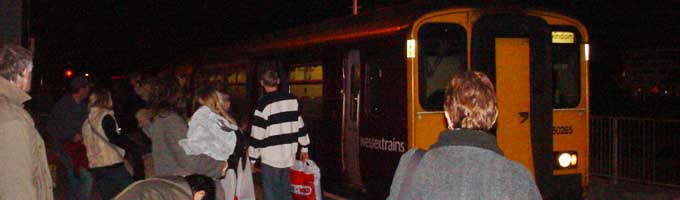
Save the Train was the campaign to bring an approriate train service back to and through Melksham. Most big contributors are still around writing at the Coffee shop forum where new members are very welcome. The train has been saved - sort of - we have stepped back up from an unusable service to a poorish one but it's doing very well. We did that through setting up the TransWilts Community Rail Partnership. That fulfilled its early objectives; it has been taken over by local and regional government types who are now doing medium and long term work. The team from this forun can also be found at the Melksham Rail User Group (which was the Melksham Rail Development Group at the time these articles were written and we had no users. We mustn't loose sight, though, that the train service remains poor and needs our community support in marketing and campaigning to keep it going in a positive direction ... and all the more so when we're expecting to find a different normallity once we get out of the Coronavirus Pandemic and head for zero carbon via the climate crisis. Yes, it's saved ... it's now a key community facility ... the need for enhancement and the strong and near-universal local support remain, and the rail industry and goverment remain slow to move and provide the enhancements even to level us up with other towns. Please support the Melksham Rail User Group - now very much in partnership rather than protest with the rail industry and local government, including GWR, TransWilts and unitary and town councils. And please use the trains and buses, and cycle and walk when you can. -- Graham Ellis, (webmaster), February 2021 | |||
|
|||
Further Information:
Home
Current Summary
Daily update
User forum
Consultation
Service now
Service future
Future Analysis
Recent Statistics
Recent letters
Letter to DfT
Save the train
Presentation
Support us
Other Maps
Station facilities
Station approach
Pictures
Trains diverted
History
About Melksham
Site Map
About this site