
| Archived Save the Train forum articles - 2005 to 2010. See below
New railway network - 1498/4066 Written by mark-scott on Sunday, 25th February 2007 Following on from the awful tradegy this weekend, it is about time something was done to the railway infrastructure in the UK, over the poast few years some of the most serious crashes have been caused by defects in the track or signalling. I think its about time the railway system was dragged kicking and screaming into the 21st centuary. What would be good is a high speed service linking the big centres of the country, this could be acheived using a maglev type system with limited stops. (say following the lines of the major motorways) the track could be elevated. The current track could then be utilised to connect the larger centres to the localities. Maybe wishful thinking but I was aware that something like that was planned for the GWR and if the rail companies, te government and private industry got together, who knows? Re: New railway network - 1498/4069 Written by admin (Graham Ellis) on Monday, 26th February 2007 One railway death is one too many, and it's excellent to look forward and have plans for the future. Re: New railway network - 1498/4090 Written by Steve35 on Monday, 26th February 2007 [quote author=Mark Scott link=topic=1498.msg4066#msg4066 date=1172443874] I think its about time the railway system was dragged kicking and screaming into the 21st centuary.[/quote] Network Rail have achieved an awful lot in the past few years with regard to getting a grip on the infrastructure. Have you ever seen the New Measurement Train? http://www.iroyoungprofessionals.org.uk/events/2006_june.shtml They must be doing something right as foreign railways have visited us to see it. See also http://www.serco.co.uk/markets/transport/railoperations.asp for details of some of the the other test trains. [quote] What would be good is a high speed service linking the big centres of the country, this could be acheived using a maglev type system with limited stops. (say following the lines of the major motorways) the track could be elevated. The current track could then be utilised to connect the larger centres to the localities. [/quote] Maglev isn't immune from accidents either: http://news.bbc.co.uk/1/hi/world/europe/5370564.stm and http://news.bbc.co.uk/1/hi/in_pictures/5372818.stm The media reporting of Friday's accident has been truly dire. As usual. In fact I've had to stop watching it for fear of throwing something heavy at the TV! I think the problem lies in the fact that the vast majority of people, journalists included, know nothing about the technical side of how railways work. Hence the inane questions that they've been asking over the past few days. Even after 20 years interest in railways I know that my understanding has only just scratched the surface so what chance has a non-interested person got? We've had 3 days of solid coverage of this accident now. I wonder how many people have died on the roads during that time? In order to inject a few facts into the debate here are the number of rail accidents that caused fatalities to staff or passengers over the past 30 years broken down into 5 year periods. 1967-1971 - 28 fatal accidents 1972-1976 - 16 1977-1981 - 11 1982-1986 - 12 1987-1991 - 10 1992-1996 - 6 1997-2001 - 4 (one of which was caused by a car driver) 2002-2006 - 2 (one of which was caused by a car driver). I think these facts speak for themselves. Notice how privatisation in the mid-90's doesn't appear to have interrupted the long term downward trend. If today's media is in a frenzy about Friday's accident what would they have made of 1967 or 1969 when there were SIX and SEVEN fatal accidents respectively? We need to accept that there will always be accidents and we need to be able to deal with them rationally without descending into hysteria and knee-jerk reactions. We need to consider the transport system as a whole - it's no good spending billions to achieve 99.9999% safety on the railways if it prices the railway out of the market and causes everyone to use their cars instead. I also feel really sorry for Network Rail boss John Armitt, a man with an engineering background (rather than purely financial) who's done a lot to turn the railway infrastructure around since the dark days of the Railtrack era. He didn't deserve this. Re: New railway network - 1498/4096 Written by Lee on Tuesday, 27th February 2007 [quote author=Steve35 link=topic=1498.msg4090#msg4090 date=1172530744]I also feel really sorry for Network Rail boss John Armitt, a man with an engineering background (rather than purely financial) who's done a lot to turn the railway infrastructure around since the dark days of the Railtrack era. He didn't deserve this.[/quote] Whether he deserves it or not , I am afraid that if the crash was a re - run of Potters Bar (as the link below suggests) then John Armitt and Network Rail are probably in serious trouble. http://news.bbc.co.uk/1/hi/uk/6399347.stm Text of Douglas Alexander statement to parliament (link below.) http://www.dft.gov.uk/press/speechesstatements/statements/trainderailment?version=1 link to index of articles |
|||
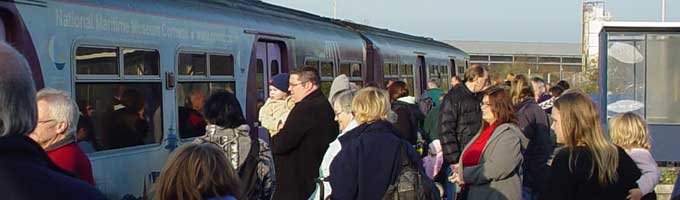
Save the Train was the campaign to bring an approriate train service back to and through Melksham. Most big contributors are still around writing at the Coffee shop forum where new members are very welcome. The train has been saved - sort of - we have stepped back up from an unusable service to a poorish one but it's doing very well. We did that through setting up the TransWilts Community Rail Partnership. That fulfilled its early objectives; it has been taken over by local and regional government types who are now doing medium and long term work. The team from this forun can also be found at the Melksham Rail User Group (which was the Melksham Rail Development Group at the time these articles were written and we had no users. We mustn't loose sight, though, that the train service remains poor and needs our community support in marketing and campaigning to keep it going in a positive direction ... and all the more so when we're expecting to find a different normallity once we get out of the Coronavirus Pandemic and head for zero carbon via the climate crisis. Yes, it's saved ... it's now a key community facility ... the need for enhancement and the strong and near-universal local support remain, and the rail industry and goverment remain slow to move and provide the enhancements even to level us up with other towns. Please support the Melksham Rail User Group - now very much in partnership rather than protest with the rail industry and local government, including GWR, TransWilts and unitary and town councils. And please use the trains and buses, and cycle and walk when you can. -- Graham Ellis, (webmaster), February 2021 | |||
|
|||
Further Information:
Home
Current Summary
Daily update
User forum
Consultation
Service now
Service future
Future Analysis
Recent Statistics
Recent letters
Letter to DfT
Save the train
Presentation
Support us
Other Maps
Station facilities
Station approach
Pictures
Trains diverted
History
About Melksham
Site Map
About this site